
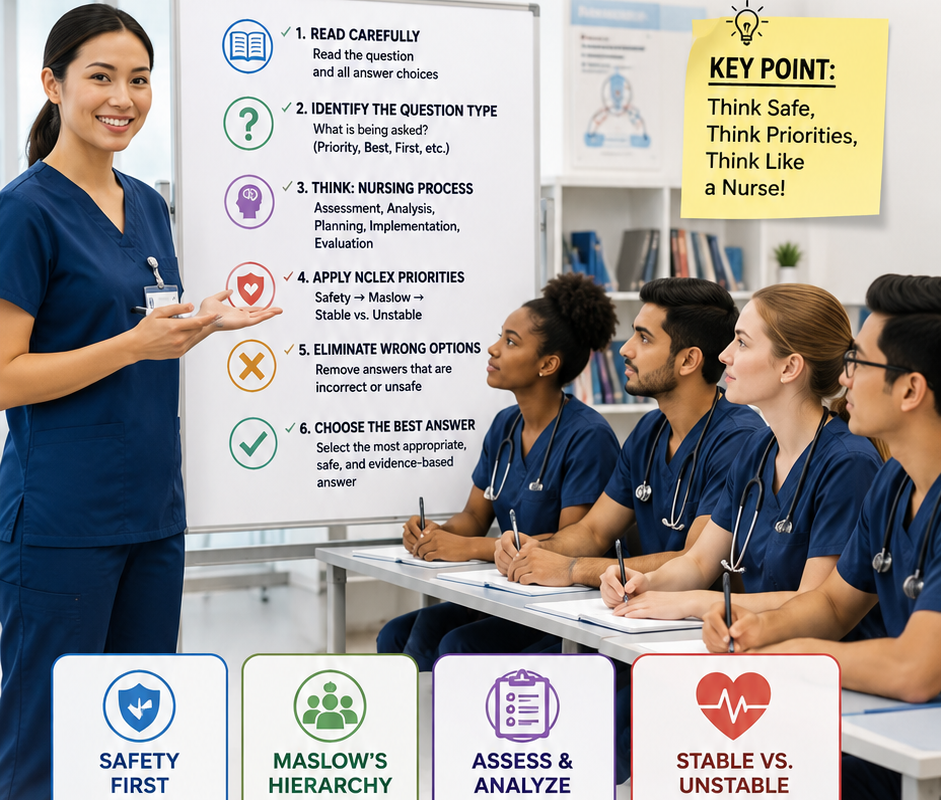
Introduction
Preparing for the Next Generation NCLEX-RN (NGN) is about much more than memorizing facts. The exam is designed to evaluate your ability to think like a nurse, prioritize patient safety, and make sound clinical decisions in real-world scenarios.
Many nursing students know the content but struggle with selecting the best answer because they lack a systematic approach to answering questions.
In this guide, we discuss eight evidence-based NCLEX test-taking strategies that can help improve your clinical judgment and increase your confidence on exam day.
1. Safety First
One of the most important principles of the NCLEX is patient safety.
Whenever multiple answers appear correct, choose the option that protects the patient from immediate harm.
Ask yourself:
- Which action prevents injury?
- Which intervention keeps the patient safe?
- Which option reduces risk first?
Remember
Patient safety always outweighs convenience, routine care, or comfort.
2. Apply Maslow’s Hierarchy of Needs
Maslow’s Hierarchy helps prioritize patient needs.
Address physiological needs before psychological or social needs.
Priority order:
- Airway
- Breathing
- Circulation
- Food
- Water
- Elimination
- Rest
- Safety
- Love and belonging
- Self-esteem
- Self-actualization
NCLEX Tip
If a patient cannot breathe, emotional support can wait.
3. Assess and Analyze Before Acting
A common NCLEX principle is:
Assessment comes before intervention.
Unless the question describes an emergency requiring immediate action, collect more information before implementing care.
Ask yourself:
- What is happening?
- What information is missing?
- What assessment should be completed first?
Careful assessment prevents unnecessary interventions.
4. Prioritize the Unstable Patient
Stable patients can usually wait.
Unstable patients require immediate nursing attention.
Examples of unstable patients include:
- Respiratory distress
- Chest pain
- Severe bleeding
- Altered level of consciousness
- Shock
- New neurological deficits
Helpful Framework
Use the ABCs:
- Airway
- Breathing
- Circulation
Then consider disability, neurological status, and patient safety.
5. Eliminate Wrong Answers First
Many NCLEX questions become easier after removing obviously incorrect options.
Eliminate answers that:
- Ignore patient safety
- Are unrelated to the question
- Include extreme words like always or never
- Delay necessary treatment
- Do not address the priority problem
Reducing choices improves your odds of selecting the correct answer.
6. Think Critically
The NCLEX measures clinical reasoning—not memorization.
Think about:
- What is the patient’s biggest problem?
- Which complication is most dangerous?
- Which intervention has the highest priority?
- What outcome is expected?
Critical thinking connects nursing knowledge with safe patient care.
7. Choose the Best Answer
Many options may be technically correct.
Your goal is to identify the best answer.
The best answer usually:
- Addresses the priority problem
- Is evidence-based
- Promotes patient safety
- Is within the nurse’s scope of practice
- Improves patient outcomes
Always ask:
“Which answer helps the patient the most right now?”
8. Trust Your Nursing Judgment
Confidence matters.
Second-guessing yourself often leads to changing correct answers unnecessarily.
Trust your preparation.
Trust the nursing process.
Trust your clinical judgment.
Stay calm and focus on the patient—not your anxiety.
Bonus NCLEX Tips
✔ Read the stem carefully before looking at the answers.
✔ Identify keywords such as first, priority, best, initial, most appropriate, and immediate.
✔ Watch for distractors that sound correct but do not answer the question.
✔ Practice hundreds of high-quality NCLEX questions with rationales.
✔ Review why every option is correct or incorrect.
Common Mistakes to Avoid
- Reading too quickly
- Ignoring assessment data
- Choosing familiar answers instead of priority answers
- Memorizing instead of understanding
- Forgetting patient safety principles
- Not practicing clinical judgment
Final Thoughts
Passing the NCLEX-RN requires more than nursing knowledge—it requires safe clinical reasoning.
By consistently applying these eight strategies, nursing students can approach even difficult questions with greater confidence and accuracy.
Remember:
✅ Safety First
✅ Maslow’s Hierarchy
✅ Assess Before Acting
✅ Prioritize the Unstable Patient
✅ Eliminate Wrong Answers
✅ Think Critically
✅ Choose the Best Answer
✅ Trust Your Nursing Judgment
Master these principles, practice daily, and you will be well prepared for the Next Generation NCLEX-RN.
Continue Learning with The Daily Nursing
At The Daily Nursing, we are committed to empowering nursing students and healthcare professionals through evidence-based education, NCLEX-RN preparation, daily MCQs, research guidance, and career development resources.
Explore more nursing articles, study guides, and exam strategies at:
Follow us for daily nursing education:
Facebook: https://www.facebook.com/thedailynursing/
Instagram: https://www.instagram.com/thedailynursing/
YouTube: https://www.youtube.com/@thedailynursing
Empowering Nurses for Global Success…